 AI Visibility Tool
See how AI talks
about your brand
Buyers ask ChatGPT and Perplexity before they ask you. CrunchJunkie is the AI visibility tool that tracks whether your brand shows up across ten AI models, how it's described, and who's winning the conversation — then ties that visibility to the real conversions it drives.
Gartner expects traditional search volume to fall 25% by 2026 as buyers shift to AI assistants (Gartner, 2024). If AI describes you wrong, you lose the sale before it starts.
Tracked across ten AI models, scanned weekly or daily
 ChatGPT
 Gemini
 Perplexity
 Claude
 Google AI OverviewsGoogle AI Mode
 Microsoft Copilot
 Grok
Grok DeepSeek
 Meta AI
How to improve your brand visibility in AI search engines
Everything you need for AI brand monitoring — monitor, benchmark and improve how AI represents your brand.
10 models, weekly or daily scans
ChatGPT, Gemini, Perplexity, Claude, Google AI Overviews, Google AI Mode, Microsoft Copilot, Grok, DeepSeek and Meta AI — automatically scanned every day.
Core visibility metrics
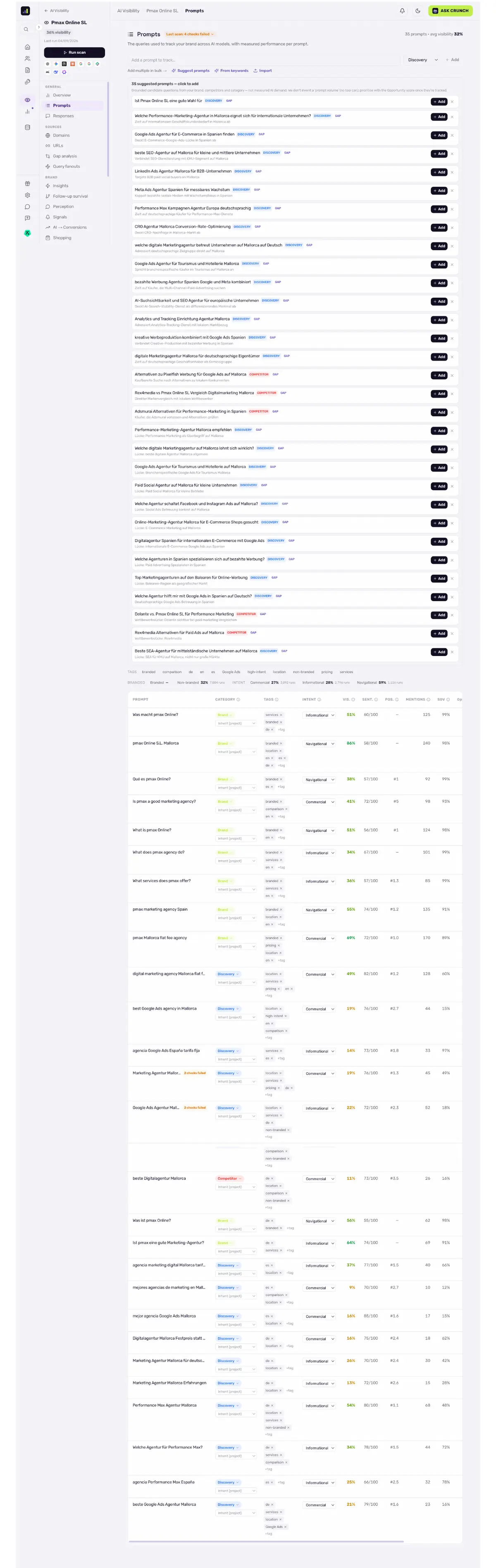
Visibility %, Share of Voice, Sentiment, and Average Position, tracked over time and broken down by model.
Prompt tracking
Group prompts by Discovery, Brand, and Competitor intent, then see per-prompt performance across every model.
Prompt discovery
Not sure what to track? Crunch reads your brand, site and competitors and suggests a well-rounded set of real buyer prompts across the intent mix — or paste your own keywords and it turns each into buyer questions. Add the ones that fit with a click.
Slice by intent, branded & features
Every prompt is auto-classified by buyer intent (Commercial / Informational / Navigational) and deterministically as branded vs non-branded, so you can slice visibility in one click — each slice with its sample size. We even flag when branded prompts inflate your headline score and show the honest non-branded number (are you recommended when nobody names you?). Filter answers by what the engine actually did, like whether it ran a live web search.
Competitor benchmarking
Line your brand up against rivals on a competitive quadrant and watch share of voice shift week to week.
Perception
Not just whether a model mentioned you — the descriptive terms it reached for (responsive, expensive, white-label), pulled verbatim from each answer. Compared against every competitor you track, with distinctive terms — used for your brand and no other — highlighted, and sample sizes throughout.
Sources & citations
AI citation tracking that shows exactly which domains and pages AI cites when it answers — the content actually shaping the response. A source-health check even flags any cited page that's dead (404) or points to a retracted source.
Insights & actions
Prioritised, plain-language strategies to improve brand visibility in AI search engines — where to win mentions, and how to close the gaps competitors are filling.
Content Briefs from real citation evidence
For every prompt where AI recommends competitors but not you: a brief built from the actual cited pages and their research-validated signals — then a per-prompt re-scan that proves the lift.
Know why a line moved
We note configuration changes on the chart automatically — market switched, engines added, competitors changed — and you add your own for launches and campaigns. No more guessing whether a step was a result or a setting.
Signals & Automations
A confidence-scored issues inbox — visibility drops, competitor overtakes, dead or retracted sources, feed & schema gaps, broken connections — raised only when a change is statistically significant, never on scan-to-scan noise. Then turn any signal into a no-code automation that emails you, posts to Slack, calls a webhook, or drafts an action plan for your approval before it's sent.
AI → Conversions
Connect GA4 and overlay your AI-search visibility with the real sessions, conversions and revenue AI assistants drive — on one chart, with an honest correlation. The one view that shows whether AI visibility is turning into revenue.
Shopping visibility
Track whether AI recommends your brand — and which of your products — for purchase-intent shopping questions, benchmarked against competitors and tied to your imported catalog.
Crawlability & crawl insights
Check which AI crawlers your robots.txt allows — with why and how to fix it — then forward your access logs to see which AI bots (GPTBot, ClaudeBot, PerplexityBot and more) actually visit, how often, and which pages they hit.
GEO Audit + Agent Readiness
A 0–100 AI-readiness score across your whole site — crawler access, server-rendered content, structured data and llms.txt — with a prioritised fix list you can have Crunch draft for you. Plus a separate Agent Readiness sub-score for the new class of real-time AI agents.
Import from Peec AI
Already track AI visibility in Peec AI? Connect a project with an API key to pull its visibility, sentiment, prompts and sources straight into your reports.
Ten models, scanned on your schedule
CrunchJunkie asks the questions your customers ask and records how each model answers — whether your brand shows up, where it ranks, and how it's described. No manual prompting, no copy-paste.
- ChatGPT, Gemini, Perplexity, Claude, Google AI Overviews, Google AI Mode, Microsoft Copilot, Grok, DeepSeek, Meta AI
- Fully automated scans — weekly or daily, on every plan
- Mention tracking with full response capture
- Trend lines per model over time
The metrics that tell you if you're winning
Visibility tells you how often you appear. Share of Voice tells you how much of the conversation you own. Sentiment and Average Position tell you whether that presence is working for you.
- Visibility % across all tracked prompts
- Share of Voice versus competitors
- Sentiment scoring on every mention
- Average position when you do appear
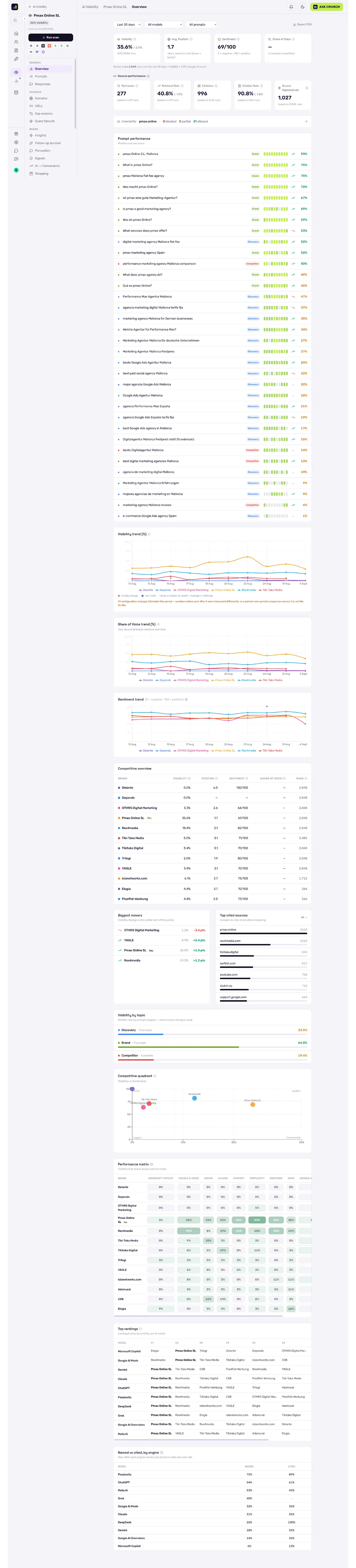
See the searches behind every answer
Engines don't answer your prompt — they run their own sub-searches first and answer from those. CrunchJunkie captures every fanout query per engine, so you know what AI actually looked for and whether you surfaced in it.
- The verbatim sub-queries each engine ran, per prompt and per scan
- Which fanouts cite you, which cite only competitors
- The raw material your content briefs are targeted against
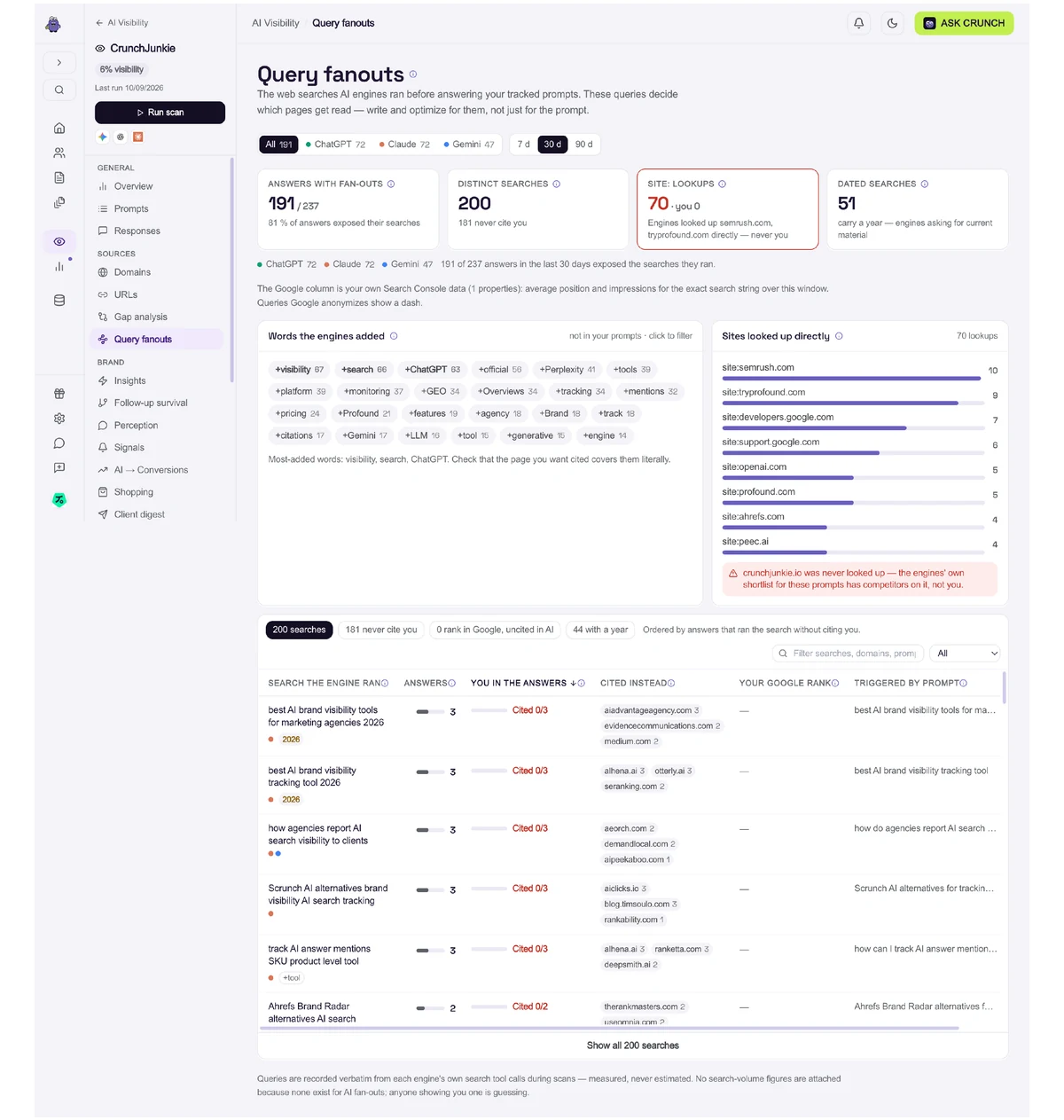
Question two is the real test
Buyers don't stop at one question — they ask which is cheapest, which does X, what the alternatives are. We ask a realistic follow-up and measure whether you're still in the answer when the conversation gets serious.
- Survival rate for the follow-up, with sample sizes
- Who takes your slot when you drop out of the answer
- Per-engine differences — surviving in ChatGPT ≠ surviving in Gemini
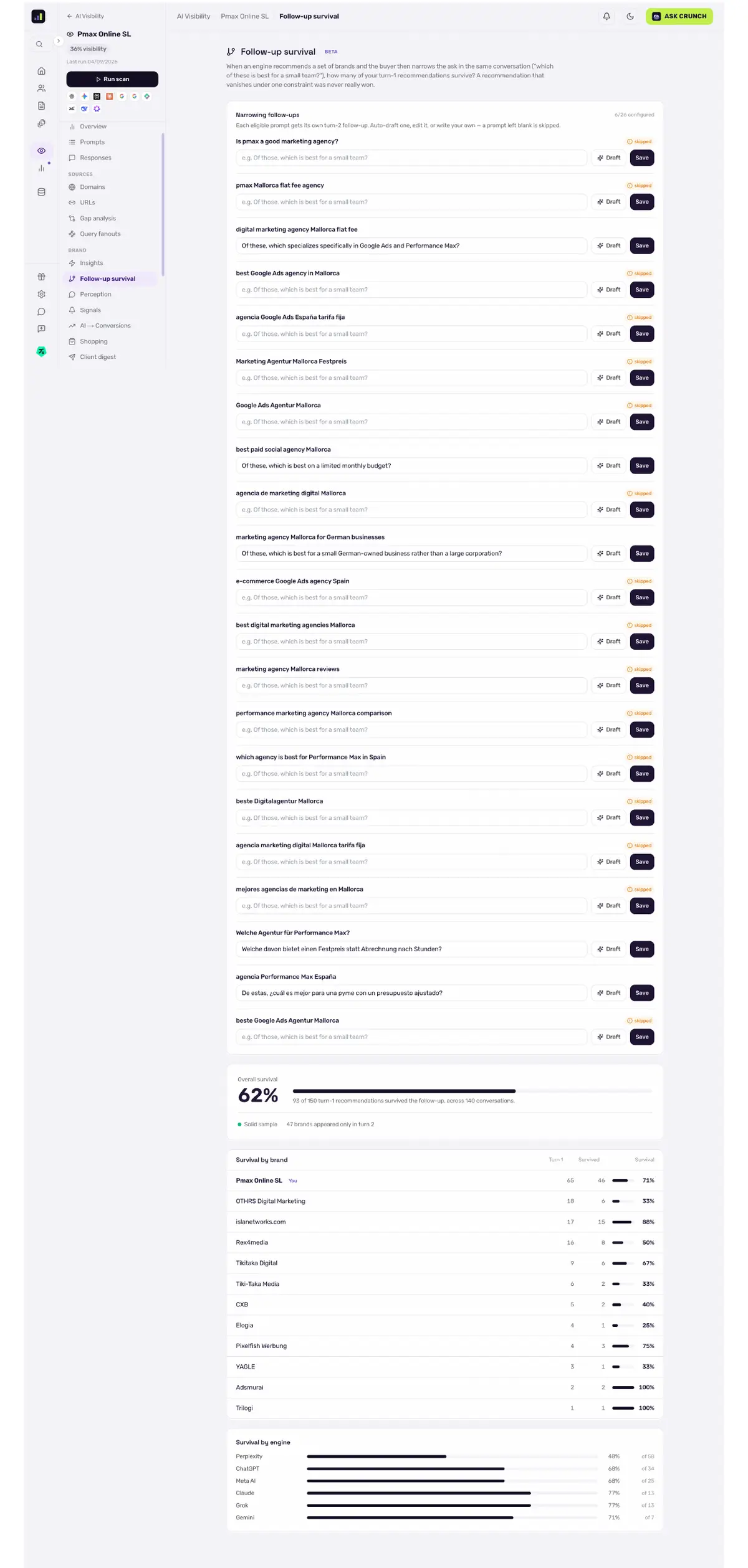
See where you stand against rivals
Add your competitors once and CrunchJunkie tracks them on the same prompts you do. The competitive quadrant shows who owns the conversation and who's gaining — so you know where to push.
- Side-by-side visibility and share of voice
- Competitive quadrant view
- Per-prompt win and loss tracking
- Mention-gap detection where rivals appear and you don't
- Perception side by side — the descriptive terms each model uses for you and for every rival

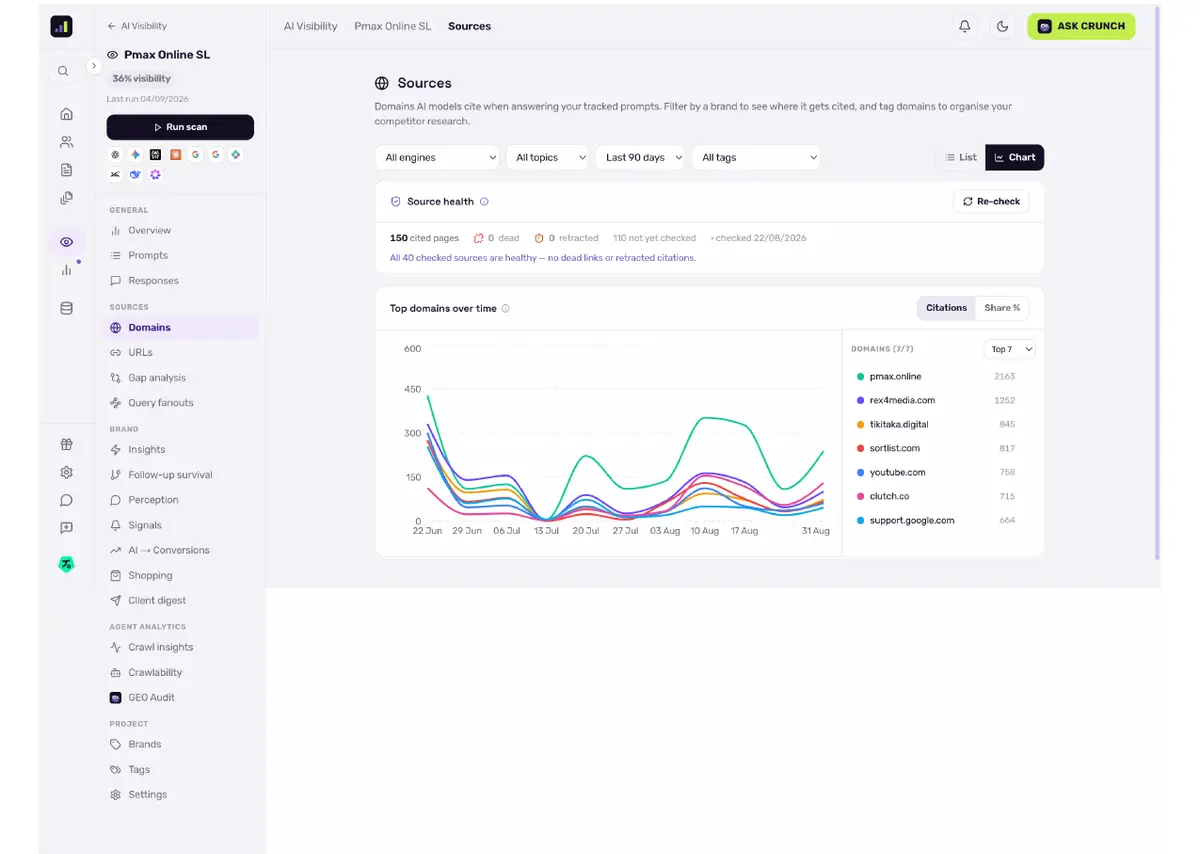
Know which sources shape the answer
AI answers are built from sources. CrunchJunkie surfaces the domains and pages each model cites most, so you can see whether it's review sites, forums, or your own content driving how you're described.
- Ranked list of most-cited domains
- Page-level citation detail
- Spot which content earns mentions
- Find the gaps to target with new content
From “not cited” to a brief you can execute
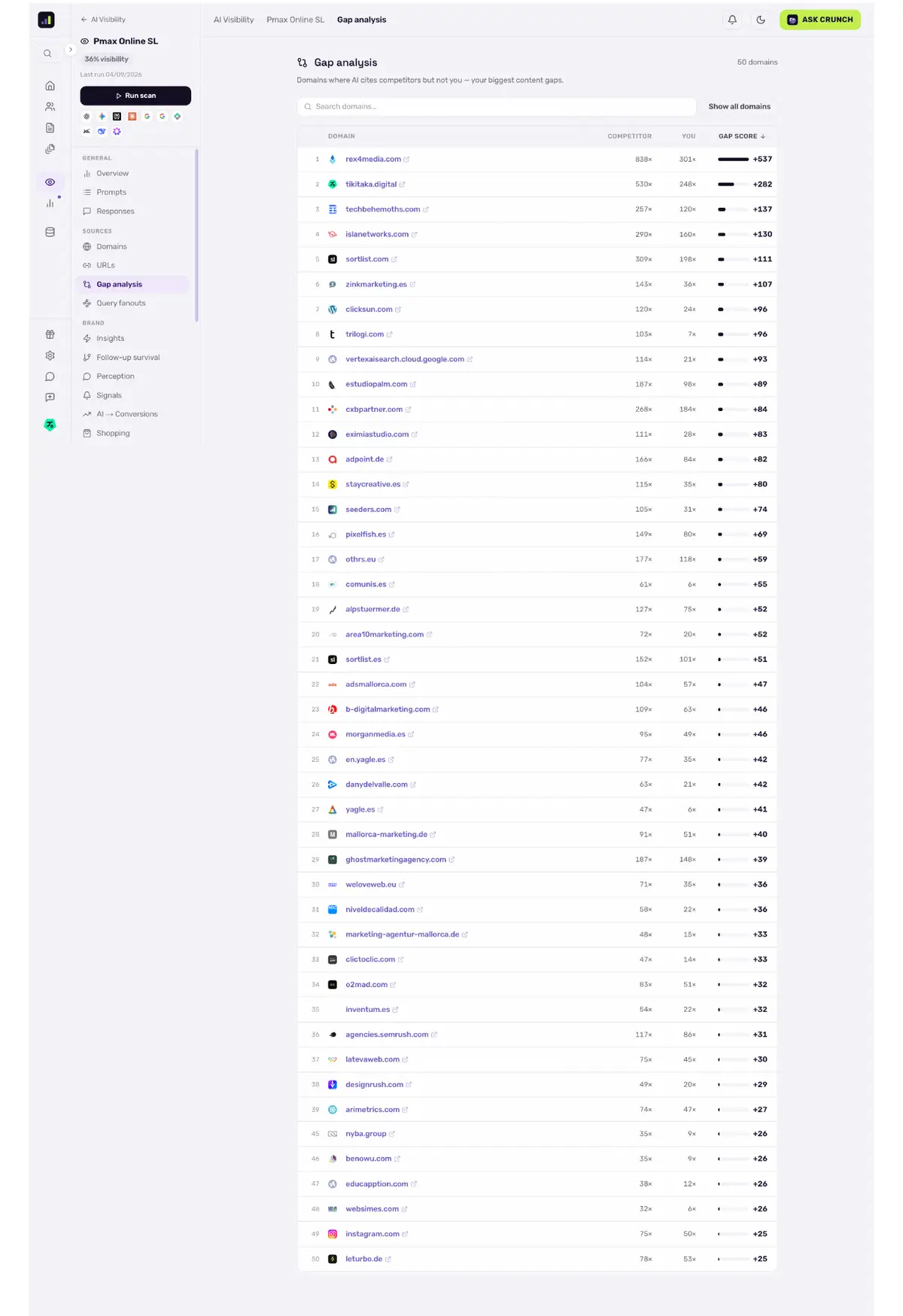
Gap analysis lists the prompts where AI cites competitors and not you. One click turns any of them into a content brief grounded in the engines' own evidence — the fanout queries they ran, the statistics and schema the cited winners carry.
- Briefs open with the quantified gap, not generic advice
- Recommendations derived from the actual cited pages
- Re-scan after shipping to measure the lift honestly
The number that tells you whether your AI visibility is working
Connect GA4 and CrunchJunkie overlays your AI-search visibility with the real sessions, conversions and revenue that follow — on one chart, with an honest correlation.
AI visibility vs GA4 sessions
Same client, same five weeks
Visibility and sessions are real client data, anonymised and published with consent. Conversion figures are illustrative. Read the five-week case study →
Visibility can climb for five straight weeks while traffic falls the whole time. Most AI-visibility tools stop at the dashboard, so that divergence never surfaces. CrunchJunkie plots both numbers on the same page, so you catch it in week one instead of week five.
- Visibility and GA4 sessions, plotted on one timeline
- Conversions and revenue tied to the same period
- Flags the gap when visibility and outcomes diverge
- Counts only the AI-referred slice of GA4, and says so — a lower bound, not an inflated number
Track the questions that matter, by intent
Organise prompts into three buckets so you know whether you're winning discovery, owning your brand, or losing comparisons.
Category questions where buyers haven't named a brand yet — "best marketing reporting tools for agencies". Winning here means being recommended before anyone asks for you.
Prompts that name you directly — "is Lumière any good?". This is where sentiment and accuracy matter most, because the model is describing you to a buyer with intent.
Comparison and alternative prompts — "Lumière vs Velora", "alternatives to Nortex". Track whether you show up favourably when buyers are weighing options.
Does AI recommend your products for the sale?
Buyers ask AI what to buy. Track your shopping recommendation rate against competitors, detect which of your products AI already suggests, and import your catalog by feed or Google Merchant Center — all inside AI Visibility.
Honest numbers, with the sample size shown
AI answers are non-deterministic, so a visibility figure is a sample — and we treat it like one. Every AI-visibility KPI shows how it was measured, in the app and in your client reports alike.
Sample size on every metric
Each KPI shows "Based on N runs" — the number of scan runs (prompts × models × repeats) behind the number — so nobody mistakes one lucky answer for a trend.
A margin of error, not false precision
Visibility % is shown with a ± margin of error, so a client can see the confidence around the figure at a glance.
Repeated runs, averaged
We run each prompt several times and aggregate, because a single manual check is one noisy sample. The trend you track is real, not a screenshot.
Want to see it first? Run the free AI-visibility check — a real sample with its sample size and margin of error, no signup.
Bring your own keys, at cost
Already have API keys for the models you care about? Connect them and you only ever pay the providers their usage rates — CrunchJunkie never marks up your AI spend. Keys are encrypted at rest and used solely to run your scans.
Or let us manage it — metered from €25/mo
Don't want to juggle API keys? Managed AI runs the scans for you on our infrastructure. Model choice is free — you pick a monthly plan with an included check allowance (from €25/mo) and pay just €0.05/check beyond it. Premium models count 3×. Turn models on and off whenever you like — set a spend cap so there are no surprises.
See Managed AI pricingMore than a mention tracker
Every tool claims to “track AI” now. CrunchJunkie does that too — with honest sample sizes — then goes two steps further than a tracker, in one platform.
Track mentions across every engine
See how ChatGPT, Gemini, Perplexity, Google AI Overviews and more mention, cite and recommend you — by prompt, buyer intent and competitor, with the sample size always shown.
Industry standardPlus a technical GEO Audit
Not just what AI says — why. A weighted audit of crawlability, llms.txt, structured data and server-rendering turns every gap into a prioritised, fix-it-yourself action plan — the technical strategies behind stronger brand visibility in AI search. Plus a separate Agent Readiness sub-score for the emerging class of AI agents.
Only in CrunchJunkiePlus full marketing reporting
AI visibility lives inside white-label client reports alongside Google Ads, Meta, GA4 and every other channel — one platform, one price, instead of a separate subscription your clients never see.
Only in CrunchJunkieThe tactics that measurably raise AI-citation rates — citing sources, adding statistics, clear structure and authoritative voice — come from peer-reviewed research (Aggarwal et al., GEO, KDD 2024). Our GEO Audit scores your site against them.
Independent industry analysis backs this too: content platform AirOps found pages with a clean heading hierarchy and aligned schema earn 2.8× higher AI-citation rates, and pages using three or more relevant schema types are ~13% more likely to be cited — the exact structural signals our GEO Audit checks.
Comparison reflects the standalone AI-visibility category (mention monitoring); specific features vary by tool. CrunchJunkie's edge is combining all three in one place.
AI brand monitoring, answered
Want the model-by-model detail? How LLM monitoring works — tracking your brand across all ten AI models
Find out what AI says about you
Run the free check to see a real, live sample in under a minute — no signup — then set up a full visibility project and start improving your brand visibility in AI search engines.
Free check needs no signup · 14-day trial · Bring your own keys or go managed